Jacquard vs Embroidered Beanies: Which Logo Lasts
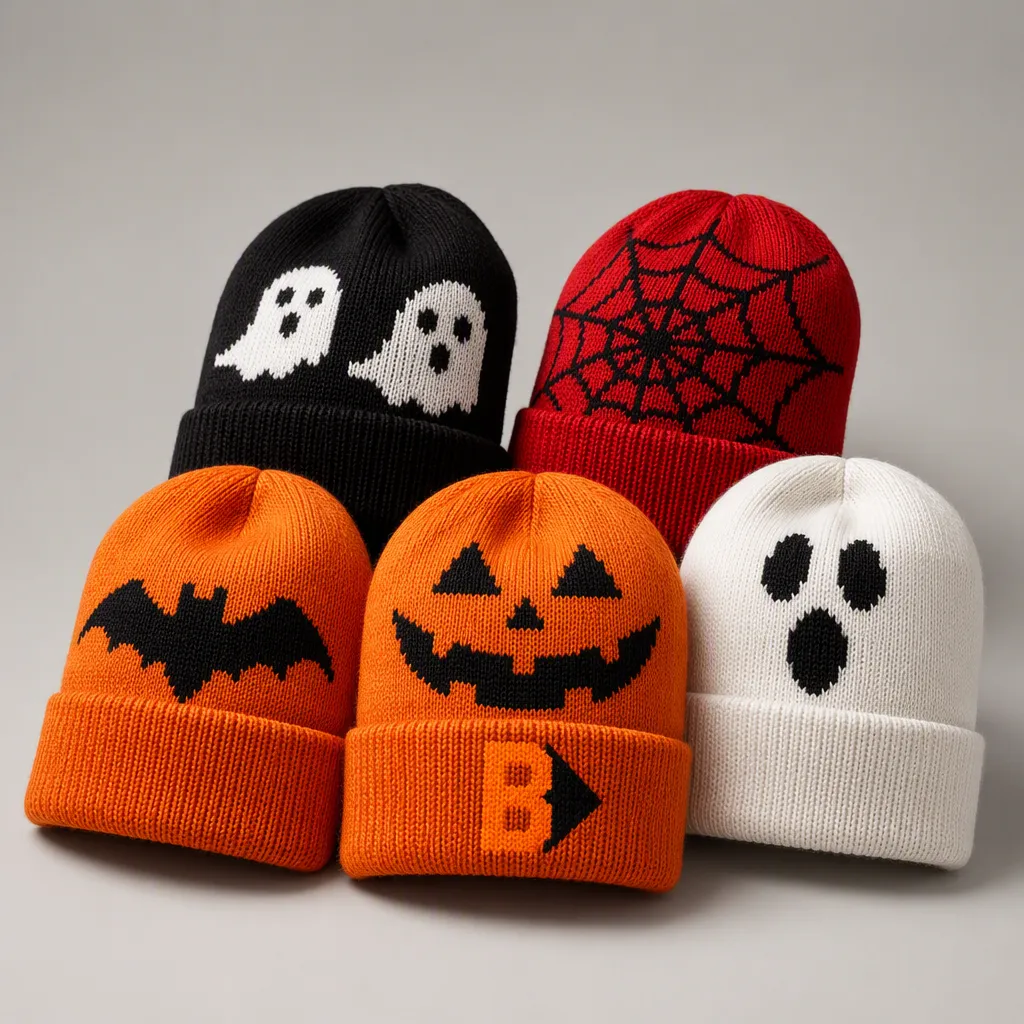
There are three ways to put a logo on a custom beanie, and they produce three different products. The choice is usually made on price, which is the wrong order — the logo technique decides how the hat looks after a winter of wear, and that is what your buyer sees.
The three options, in one line each
- Jacquard knitted in — the motif is produced by the machine as part of the fabric, row by row
- Embroidery — thread is stitched onto a finished knit
- Woven badge — a separate woven label is sewn onto the surface
Everything below follows from that difference.
Jacquard knitted in
The colour is the fabric. There is no layer sitting on top, which is why a knitted-in logo cannot peel, crack or lift at the edges — there is nothing to peel.
Strengths: survives repeated washing and hard wear, holds fine detail and lettering, hides nothing, and can wrap around the cuff or run all-over the crown.
Constraints: the palette is limited by the chart. Every additional colour is another yarn feed and another colour change on every row, so colour count is the main cost lever. This is why a knitted-in design rewards a disciplined palette and punishes a gradient.
Best for: brands that want the logo to be part of the product rather than applied to it — and any programme where the beanie will actually be worn, not filed away.
Embroidery
Thread on top of the knit. It gives a raised, dimensional logo with a tactile edge that knitting cannot produce.
Strengths: dimensionality; thread colours are cheap and effectively unlimited, so gradients and fine multi-colour crests are practical; no chart programming per colour.
Constraints: it adds a treated surface to a soft knit — on a beanie with stretch, dense embroidery can stiffen the area it covers. There is usually a one-off digitising fee per design, and heavy coverage takes longer to run.
Best for: corporate crests, club badges, and any logo that needs depth rather than longevity in the wash.
Woven badge
A small woven label sewn on. The cheapest of the three to set up, and the easiest to change between seasons.
Strengths: low setup, quick to produce, a clean way to test several designs without a new knit program.
Constraints: it is visibly an applied element, it can lift at the edges, and it adds a sewn edge to a knit surface. On a premium beanie it reads as a shortcut.
Best for: fast promotional runs, sampling several logo ideas, and price-first giveaways.
Side by side, on the criteria that actually matter
Wash and wear. Knitted in wins decisively — it is the fabric. Embroidery holds for a long time but the stitched area can pucker with repeated washing. A badge is the first to show edge wear.
Colour and detail. Embroidery wins on colour count and gradients. Knitted-in wins on integration and on fine line work that follows the knit structure. A badge is limited by the label size.
Cost behaviour. A badge has the lowest setup. Knitted-in has a real setup cost — charting and machine programming — that is fixed per design, so its economics improve as the run gets longer. Embroidery sits between, with a digitising fee rather than programming.
Lead time. All three run on similar production timing; the difference is queue pressure. Beanie capacity tightens from October through the holiday season whichever method you choose.
How it looks in year two. This is the honest test. The knitted-in logo still looks like the day it shipped. The embroidered logo looks slightly aged. The badge has an edge you can pick at.
How to decide
If the beanie is merchandise people will wear, knit the logo in.
If the logo is a crest with many thread colours, or needs to be raised, embroider it.
If you are testing three designs before committing, order badges first and knit the winner in for the real run.
If the answer is "cheapest possible", be clear about what you are buying: a hat with a label on it, not a branded knit.
The question to ask your supplier
Not "how much per piece", but: can you make all three, and which one does my artwork suit? A supplier who only offers one method is selling you their production line rather than your design.
We run jacquard, embroidery and woven badges on the same floor, so the recommendation is not driven by what we would rather produce — see custom beanie manufacturer for how each is produced, or go straight to wholesale, private label or promotional beanies.
Related: How to Choose a Custom Beanie Manufacturer · Custom Jacquard Beanies: MOQ, Lead Time & Logo Options · Print vs Jacquard: Which Lasts