Three Questions a Trading Company Cannot Answer
Every website says the same sentence: we are a direct factory, no middlemen.
It is on the sites that own machines and on the sites that forward your file to somebody else.
The sentence tells you nothing, because it costs nothing to write. The difference has to be found somewhere else — in details that only exist on a floor.
Question one: which gauges do you run, and on which machines?
Gauge is needles per inch. A knitting floor has a range, and the range comes from the machines standing on it.
A real mill answers with a specific span and often names the machine class. It knows this because the answer is the equipment list.
A trading company either repeats a range it read somewhere, or answers with something general about capability.
Ask a follow-up: which gauge would you use for my design, and why? The answer should sound like a decision made on a floor, not a preference.
Question two: which processes are yours, and which are outsourced?
This is the question most suppliers avoid, which is exactly why it is useful.
Almost no factory does everything. Linking, washing, embroidery, printing, label sewing, packing — some are in-house and some are not. That is normal.
The difference is whether the supplier will name the split.
A factory says: we knit and link here, the wash house is a partner two streets away, the embroidery is outsourced. Here is who does what and what their lead time does to yours.
A trading company says: we do everything, all in-house, do not worry.
The second answer is usually not a lie about capability. It is a refusal to expose a chain it does not control.
Question three: can I see the floor on a video call?
Not a video. A call, live, with someone walking.
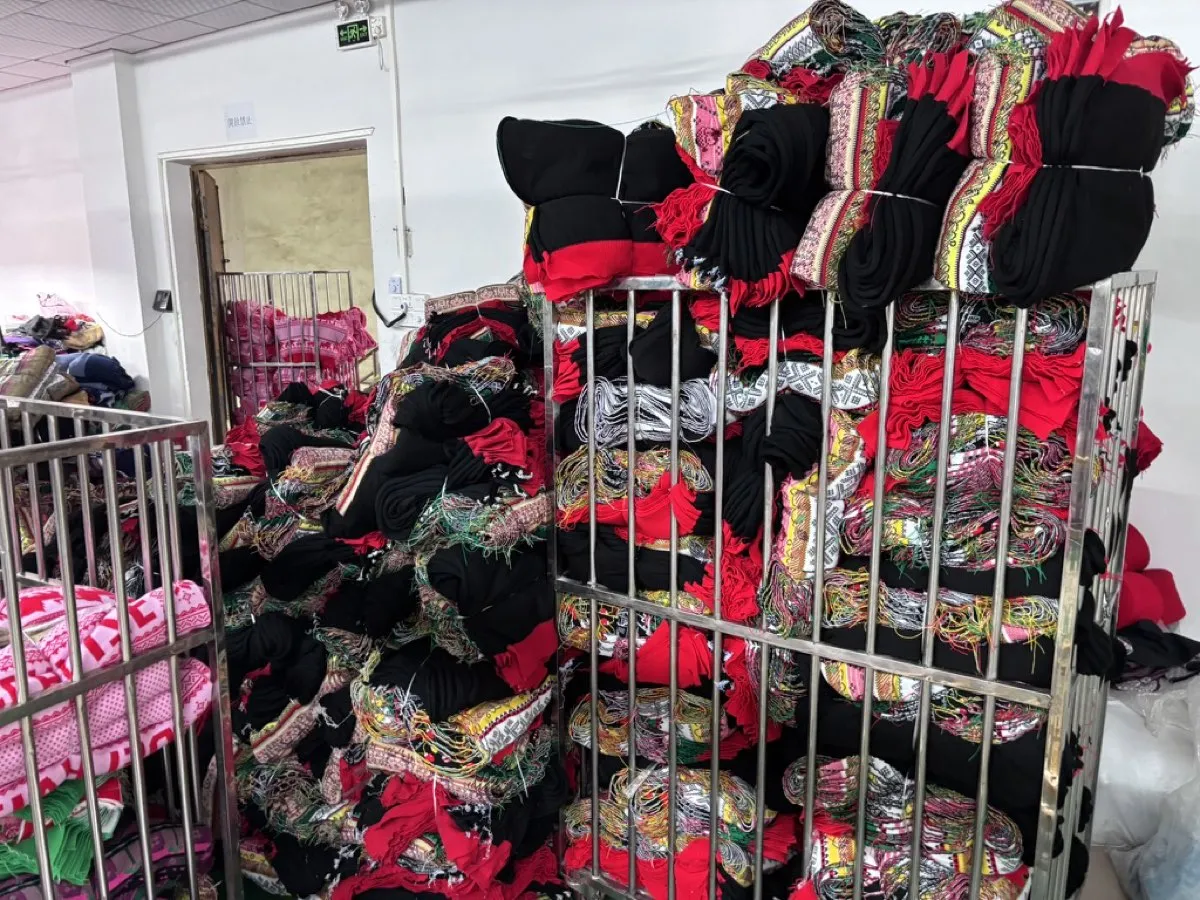
A mill can do this in ten minutes and will often offer it. There is nothing to prepare: the machines are running and the floor looks the same every day.
A trading company will offer a product video, a factory tour recorded last year, or a reason why the factory address is inconvenient this week.
Why these three and not the licence
A business licence is worth checking, and we will send ours on request. But a licence tells you a company exists legally. It does not tell you who owns the machines.
The three questions above are about physics and scheduling. They cannot be answered convincingly by someone who is not standing next to the equipment.
What we answer
We knit and link in Dalang, on our own flat-knit machines. Woven and cut-and-sew work is also ours. Everything else — hard goods, printing on some substrates, certain finishing — comes from partner workshops, and we say which.
We tell you when a process is outsourced, and what it does to your date. Your critical path is set by the slowest step, so hiding a step does not help you.
Ask for the video call. We will walk you round.
Related: Four Questions That Prove Whether They Can Really Knit It · One Supplier Who Owns the Result · Custom Beanie Manufacturer