Custom Jacquard Socks: Wrong Sample to Repeat Order
The first knitted sample of this project looked wrong — and it wasn’t anyone’s fault. Here’s the full walkthrough, mistakes included.
I’m Ted, founder of Bente (bentepromo.com) — a custom promotional products and corporate gifts business with our own knitting factory and certified partner workshops. Distributors, brand teams, and small businesses come to us for small-batch custom pieces, and knitted jacquard socks are among the items buyers ask about most.
I can’t name the client in this story — that’s a rule I keep with every project. But I can walk you through the whole thing, because everything in it is what a typical custom sock program looks like from the factory side. If you’re planning branded socks, you will meet these exact situations.
The brief
A promotional products distributor in Europe was putting together a corporate gift program for one of their end clients — an anniversary year, so the gift had to feel earned, not generic. They wanted knitted socks with the anniversary mark knit into the leg and a small wordmark on the cuff, colors pulled from brand guidelines, in a full size run. Quantity was a mid-size batch — the kind that very large factories often decline and marketplaces can’t produce properly.
Why socks for a corporate gift in the first place? They’re one-size-flexible, suit everyone, cost less than most apparel gifts, and — done in jacquard — carry the brand into daily wear for months. That’s exactly the kind of piece we build our gift programs around.
Why the artwork couldn’t go straight to the machine
The files we received were beautiful — and built for screens, not for knitting.
Eight colors, including a gradient. A thin serif wordmark. Fine outlines around the anniversary mark. On a monitor: perfect. On a knitting machine, each stitch is a physical loop, and the design has to be rebuilt on that grid, yarn color by yarn color. The gradient would turn into bands of similar shades. The serif text at that size would blur into noise.
This surprises buyers every time, and it shouldn’t. A knitted sock is fabric engineering, not paper printing. The artwork has to be translated — and that translation is where most sock projects are quietly won or lost.
Sampling round one — where it went sideways
We knitted the first swatch with the original color plan. The result: the two adjacent brand colors sat too close in value, so the pattern muddied where they met, and the serif wordmark on the cuff was barely readable.
Was that a factory failure? No. That’s the physics of loops and fixed resolution. This is exactly why sample rounds exist — and why I get nervous when a project jumps straight to bulk on complicated art.
I sent the distributor photos of the knitted swatch next to the artwork, with a plain explanation of what the machine could and couldn’t hold. No blame, no excuses — just the gap between screen and knit, made visible.
The fixes we made together
Three changes, all decided with the client, not for them:
We cut the palette down to four yarn colors, keeping the two highest-contrast ones as the pattern anchors. Suddenly the mark read clearly at arm’s length.
We replaced the serif wordmark with a heavier, blockier version of the same name, enlarged one step. Same brand, new lettering logic — built for loops instead of pixels.
We moved the smallest design element from mid-pattern up to the cuff, where the fabric is denser and fine work holds better.
Then we previewed the revised design in our knitting software, on the actual stitch grid, before committing yarn to it. That preview step costs little and routinely saves a sample round.
Bulk production, and what we actually check
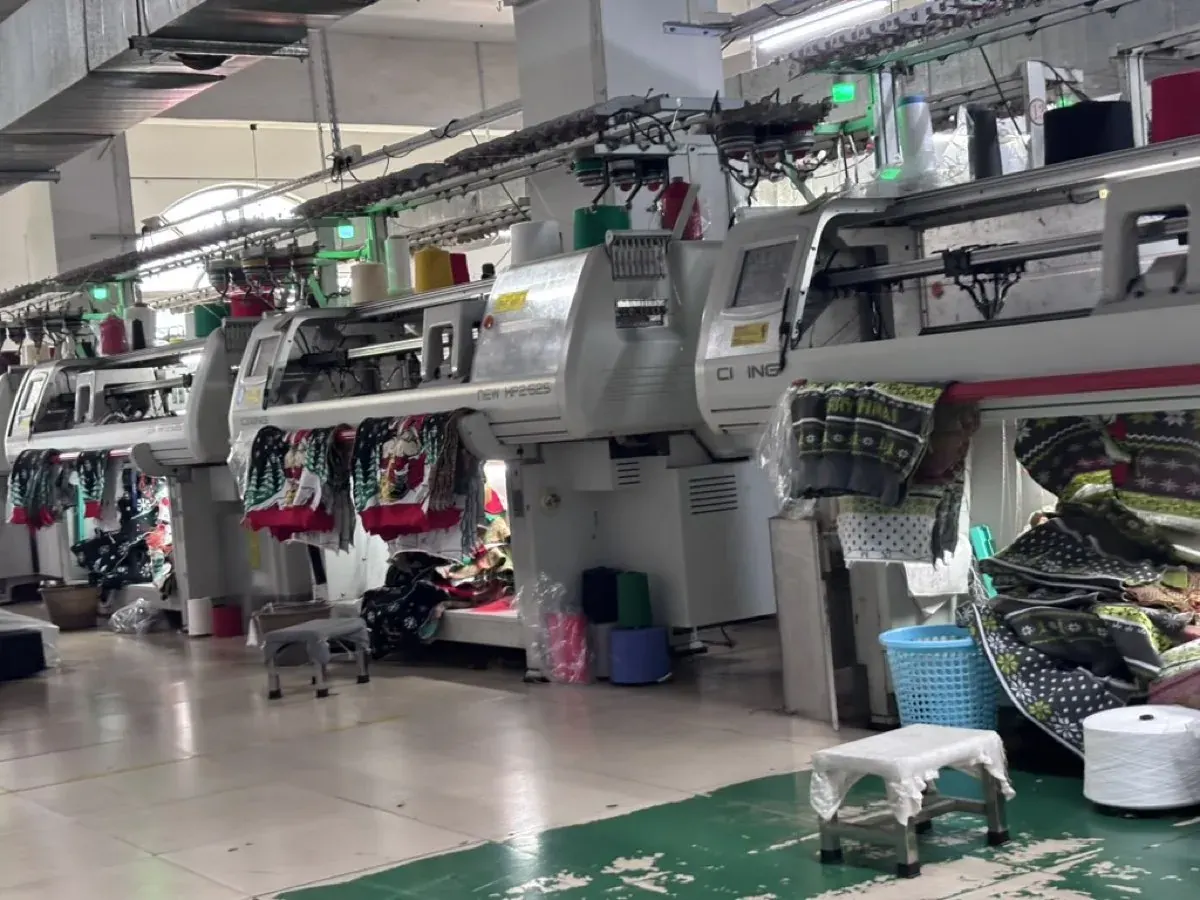
Once the second sample was approved — and it was, with no further changes — the run went to our own knitting floor, with finishing and packaging handled with our certified partner workshops.
What we check on jacquard socks, in plain terms:
Pattern alignment: the motif must sit consistently on every sock, same height, same position.
Stitch density and tension: a loose sock feels cheap and wears badly; a tight one distorts the pattern.
Color consistency across the run: yarn lots vary, so we plan for that before starting, not after.
Size accuracy after washing: each size in the run has to still be its size once the client’s end user wears and washes it.
None of this is glamorous. All of it is why the socks that arrive feel like the sample that was approved.
The result
Second sample approved, bulk delivered, program completed — packaged as individual gift units, ready to hand to the end client’s team. And the part I value more than any compliment: the distributor came back the following season with a different end client and a new sock brief. In this business, the re-order tells you more than the first order ever will.
The project shape, in typical terms: artwork translation plus a couple of sample rounds up front, then production — with timing that depends on quantity, yarn availability, and season. I won’t invent a magic number here; any supplier who promises exact dates before seeing your artwork is guessing.
What to take from this project
Three things I’d hand to anyone planning custom jacquard socks:
Simplify before you’re asked to. Fewer, bolder colors almost always read better in knit than a faithful reproduction of a complex logo.
Budget time for samples on detailed art. Two rounds on a detailed design is normal, not a failure.
Work with someone who shows you knitted reality, not just renders. A software mockup has never survived contact with a knitting machine.
If you’re sitting on a logo right now, wondering whether it would knit cleanly — send it over via the inquiry page. I’ll tell you straight what will translate, what won’t, and what we’d change. No pressure; a straight answer is how I’d want to start any partnership.
— Ted, founder of Bente. Custom promotional products and corporate gifts, own knitting factory, small-batch custom. bentepromo.com
Related: Custom Jacquard Socks: A Manufacturing Case Study · Custom Jacquard Socks — the product · Free Mockup Studio